Fall 2025
Public announcement and internal preparation
April 30, 2026
First event pour les opérateurs et gestionnaires de flotte au Centre national de conduite d’engins de chantier de Lévis
Fall 2026
Start of field tests
Spring 2027
Mid‑project event
Summer–Fall 2027
Second round of field tests
Winter 2028
Third round of field tests (if needed)
Spring 2028
Final event and publication of the project’s synthesis guide
Real‑World Field Testing
Run from 2025 to 2028, the Plug-in Fleet Heavy Equipment project aims to test, measure, and share results related to the electrification of heavy construction and industrial machinery.
The project includes six field trials each lasting two weeks scheduled between spring 2026 and spring 2028. During these trials, a range of fully electric equipment, such as excavators, wheel loaders, and backhoes, will be tested in real operating conditions within the day‑to‑day activities of participating companies in Québec. Customized charging solutions will also be deployed at each location to document and share practical insights on a key electrification challenge: planning and managing charging on worksites.
These trials will generate both quantitative and qualitative data related to performance, range, operational conditions, environmental benefits, and operating costs compared to diesel machinery. At every stage, easy‑to‑understand technical reports will be released to provide Québec’s ecosystem with reliable and neutral information.
Third Iteration of the “Plug-in Fleet” Initiative
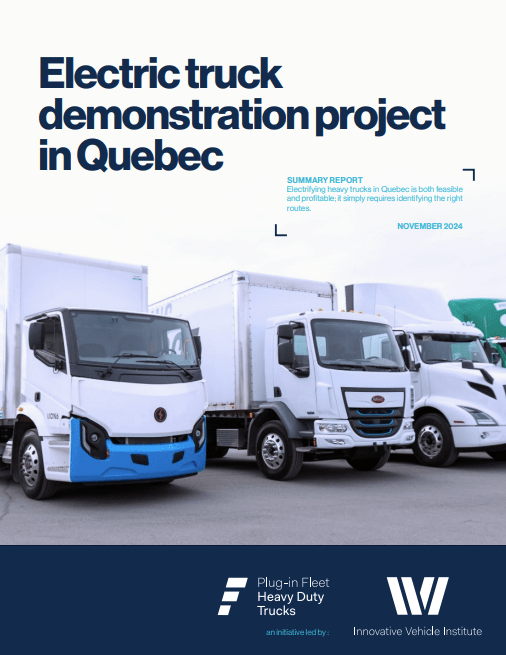
This project builds on the expertise developed by the Institut du véhicule innovant (IVI) through previous projects Plug-in Fleet – Light Vehicles and Plug-in Fleet – Heavy Duty Truckscompleted over the past few years. These initiatives were carried out using a rigorous methodology grounded in experimentation, analysis, and transparent communication of findings, with the goal of equipping ecosystem stakeholders and helping them make informed investment decisions.
These demonstration-based projects allowed managers to try out electric vehicles in real operating environments, making it easier to assess their performance and how well they could be integrated into day‑to‑day operations. By testing both the vehicles and the charging stations over an extended period, at no cost or risk to participants, the project created a safe and accessible learning environment. It also served as a credible, neutral, and unbiased source of information, supporting well‑informed and objective decision‑making.
The IVI team notably organized the largest gathering of electric truck models ever tested in Québec.
Telematics‑Based Analysis
As part of the Plug-In Fleet – Heavy Equipment project, the analytical approach is built on a structured methodology: observe, analyze, anticipate. Before real‑world testing even begins, the project analyst lays the essential groundwork needed to thoroughly understand the transition toward electrifying worksites. Through ongoing technological monitoring and technology watch through continuous technology monitoring and advanced simulations, the analyst identifies emerging trends and assesses their potential impact on operations in Québec. This work supports the development of reliable digital‑twin models of reliable digital twins of electric machinery, built using data gathered from the operation of diesel‑powered equipment. To achieve this, the analyst develops instrumentation methods tailored to each machine instrumentation methodologies tailored to each machine, deploys neutral and accurate telematics, and compares the performance of electric and conventional equipment over the medium and long term under similar operating conditions. This rigorous approach ensures that every data point matters and that every decision is built on a solid foundation.
Data sharing
Because a transition that is imposed, without listening or proper support, has little chance of succeeding. Conversely, by identifying best practices, understanding the barriers, and removing the obstacles, meaningful and lasting change becomes achievable. The project aims to structure the industry in a way that supports a healthier transition and provide stakeholders with practical tools so that this shift can truly succeed on the ground.
To follow the progress of the project and receive early insights, subscribe to our newsletter and stay connected through our LinkedIn page.